
A truism I have found useful: Models are not fungible, but they must be replaceable. To that end, I’ve spent a fair bit of time fiddling with which models are most useful for which roles in the factory. Having just shipped the 0.0.19 build, I wanted to take a moment to talk about where things currently sit.
Scaling Process
If you’d told me when I started my career that the halting problem would be complicated by a piece of software deciding it doesn’t feel like stopping, I might’ve picked a different career.
Two recurring failure modes have been coming up in this project. For a while I thought one of them was Crawford-Sobel signal degradation. It isn’t. Going down the rabbit hole to falsify my hypothesis has proven interesting. One may involve Goodhart-like proxy optimization. Both involve unpriced false positives (the bots produce garbage because nothing has penalized them for not doing so) and inadequate stopping criteria (the bots just keep producing garbage without end).
So let’s talk about that a bit.
A Big Win, and a Change of Pace
Real life has intervened, so I’m slowing down my pace a bit. There’s a combination of factors at play, but all of them involve chaos in my non-programming life.
I have, however, still been making progress on both the game itself and the process. And that progress has already resulted in a PR that genuinely surprised me.
Roost, Terrain, and Sound
The last few posts have been heavy on the structural elements of what I’m doing and how I’m working to make LLMs work for me effectively without micromanagement, and seeing how far I can push things before that begins to come off the rails. This post is going to include a little bit of an update on the structural element, but it’s also a chance for me to show off a bit more player-facing shininess.
The game now has music and sound effects, with an infrastructure that will help me deal with a design problem that plagued me in the first two games. It also has a terrain system that doesn’t look like programmer art.
One key thing to note before I get into it: I am not using AI to produce art assets for the game, beyond a placeholder company logo and some very generic-looking placeholder UI elements. All actual art and sound in the game is human-produced.
Quality Requires Visibility
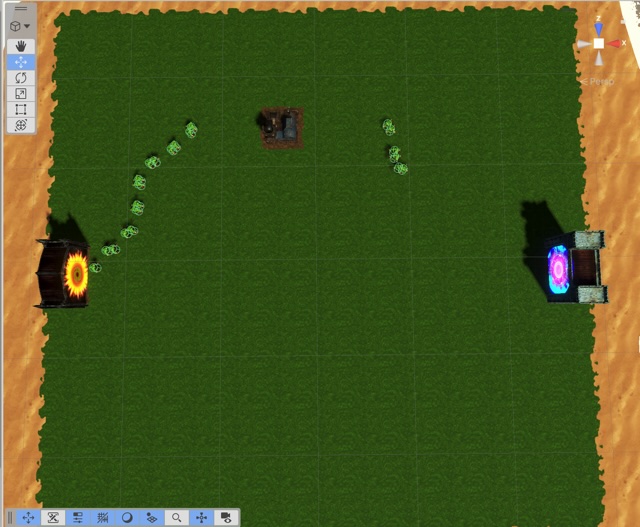
Quality requires visibility. You cannot fix — or even trust — what you cannot see. That’s true in any project, but it becomes even more urgent when the team doing the work is a software factory and you’re not reading every line of code.
When I’m not micro-managing the implementation, the thing I’m actually managing is my own insight: the gap between what the system was intended to do and what it’s actually doing. So let’s go over a little bit of what I’ve done to ensure I’ve got the visibility I need to ship a robust experience while using unreliable coding agents to do the heavy lifting.